Steel has been a mainstay of the built world for barely a century and a half — a short career for a material that now holds up almost everything. Once cheap steel arrived it was put to work everywhere at once, for the same two reasons it still is: it is strong for its cost, and it can be made into almost any shape a fabricator can draw.
This page follows standard mill forms out of the rack and into the objects they become.
Independent reference. This is an independent, non-commercial reference on metal forms, grades and mill processes. It sells nothing, quotes nothing and takes no orders, and it is not affiliated with any metal supplier, distributor or mill. See about this reference.
Flat bar and square bar
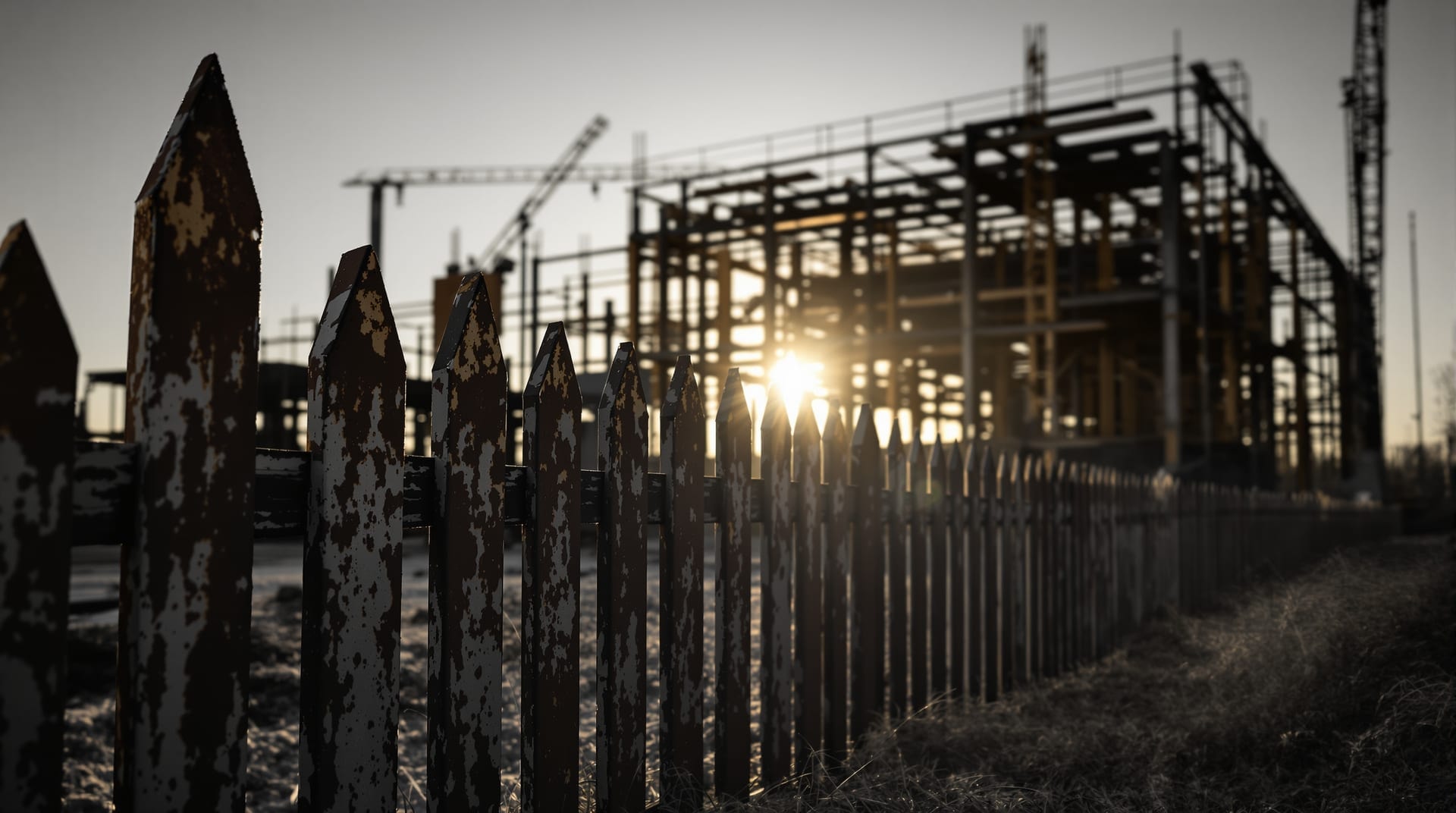
Flat bars and square bars are among the most widely used metal forms, and the most traditional use is fencing. Picket, palisade and bar fencing all resolve to flat or square bar welded to a frame — residential garden fences, commercial perimeters, and the high-security enclosures around substations and chemical plants. Where a fence stands near the ocean or in a persistently humid climate, aluminium is often substituted to avoid the corrosion that overtakes uncoated steel.
The second major use is strapping: flat steel band used to secure heavy freight to pallets and flatbeds. Think of it as an industrial version of the twine that once tied parcels — the same idea scaled up until it can hold a machine tool onto a trailer at highway speed.
And the simplest use of all is the fire poker. A length of square bar, a twist, a point, and a loop for a handle: the tool has not changed in three hundred years because there is nothing about it left to improve.
DOM tubing
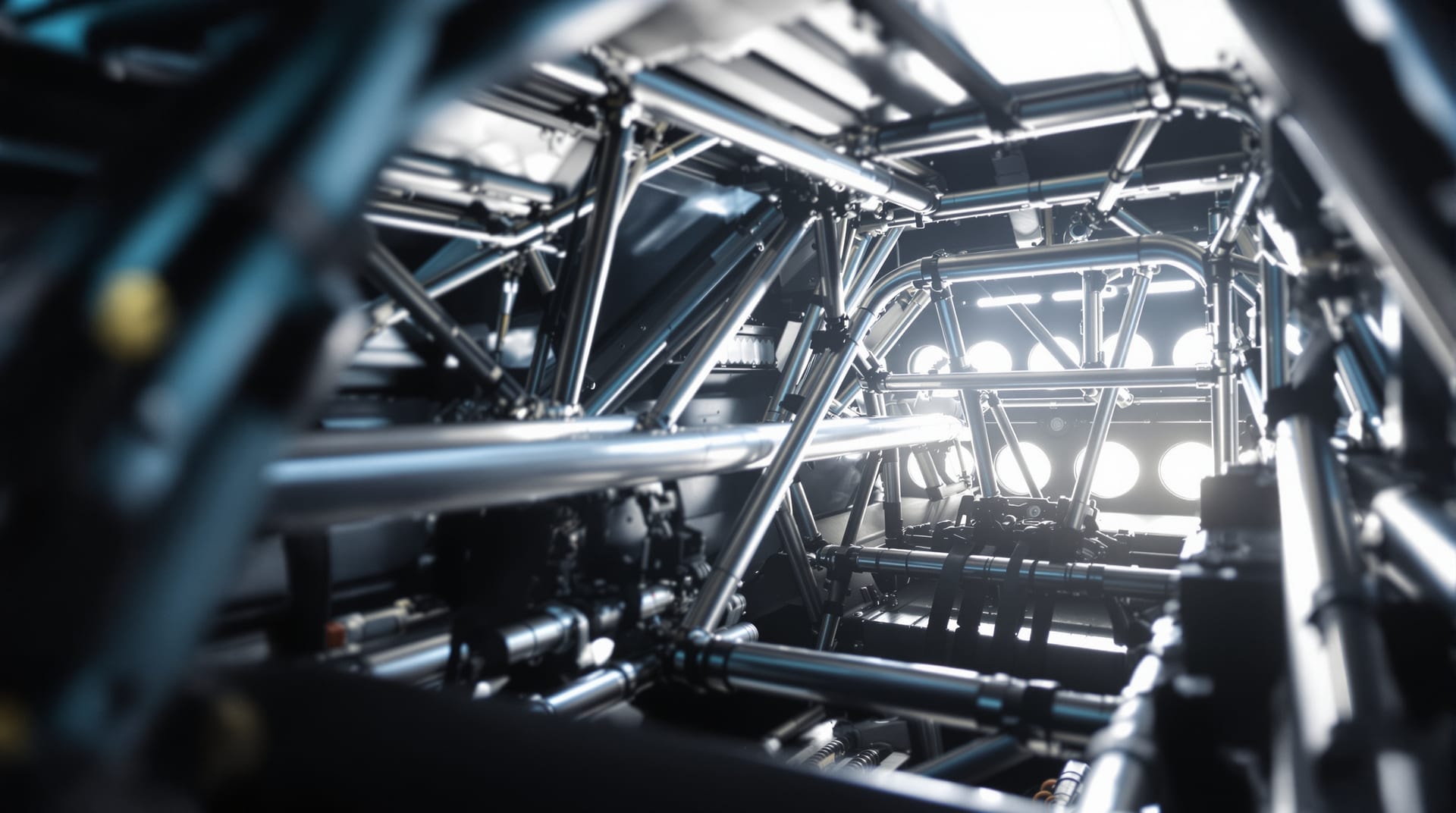
DOM stands for drawn-over-mandrel, and it describes a manufacturing route rather than an alloy. A strip is formed into a tube and electric resistance welded; the weld flash is removed inside and out; and the tube is then cold drawn through an external die over an internal mandrel. The cold working raises strength substantially, and drawing over a mandrel gives excellent concentricity between the outside and inside diameters. The mechanics are the same as those described under tube drawing.
The most demanding common application is the roll cage in a racing car, where the tube has to absorb an enormous impact without folding, and where consistent wall thickness all the way round matters because the weakest point governs. DOM's signature characteristic is that the weld seam is worked away to invisibility, leaving a sound, uniform structure that is hard to achieve in cruder tube. The same product ends up in far less dramatic places too — chair frames, exercise equipment, basketball hoop posts, hydraulic cylinder bodies.
The full technical treatment is in the note on DOM tubing.
Hot rolled versus cold worked, in service
Hot rolled steel is formed at high temperature, which makes it cheap, easy to produce in large sections, and comparatively forgiving to weld and fabricate. Cold worked steel is stronger and dimensionally tighter but has been stressed by the working process, so it moves when it is machined asymmetrically. In practice the choice is nearly always decided by whether the finished dimension matters more than the price. The distinction is set out in detail on the hot rolled steel page.
Copper and brass in the built environment
Copper and brass enter buildings for different reasons from structural steel. Plumbing and heating tube must be formed, joined and routed through tight spaces while tolerating the service environment. Electrical busbar and earthing conductors depend on conductivity and reliable connections. In both cases strength matters, but it is rarely the first property on the selection sheet.
Brass earns its place in valves, fittings and door hardware because it machines cleanly, forms into detailed shapes and presents a finish that can be polished or allowed to tarnish. Marine and architectural fittings add corrosion behaviour to that list. The service conditions still govern: water chemistry can make dezincification the controlling failure mode, while mixed-metal assemblies need attention to drainage, isolation and exposure.
These uses also explain why "copper alloy" is not a complete specification. Pure copper chosen for a conductor, cartridge brass chosen for a formed cover and free-cutting brass chosen for a machined fitting solve different problems. The brass and copper stock guide separates the common grades; the note on copper beyond the alloy rack follows the same element into biological handling and regulated surface claims.
Beams
Almost everyone has seen a steel beam in use, even if only through the open side of a building under construction. Beams are the skeleton of commercial structures — particularly multi-storey ones — and they turn up in houses too, wherever a wall has been taken out and something has to carry what the wall was carrying.
The I-shape is not arbitrary. Bending stress in a beam is concentrated at the top and bottom faces and falls to nothing at the neutral axis in the middle, so material in the middle earns very little. Moving that material out to flanges top and bottom and connecting them with a thin web produces far more stiffness per pound than a solid bar could; see I-beam. The same reasoning explains crane booms, which are beams that have to be light because they have to be lifted along with the load.
Angle
Steel angle works alongside beam. It makes the connections — the cleats and gussets that join one member to another — and on its own it makes frames: the rails and cross-members of transportation trailers, the edges of platforms, the lintels that carry masonry over an opening, the bracing that stops a rectangular frame from folding into a parallelogram.
Bracing is worth dwelling on, because it is the clearest demonstration of why triangles matter. A four-sided frame with pinned corners has no inherent resistance to racking; add one diagonal and it becomes two triangles, and triangles cannot change shape without changing the length of a side. A single length of angle bolted corner to corner converts a wobbling frame into a rigid one, which is why bracing turns up in scaffolding, gate frames, shelving and roof structures alike.
Reinforcement, walkways and the rest
Concrete is strong in compression and weak in tension, so it is cast around deformed steel bar — rebar — which takes the tension the concrete cannot. Expanded metal and bar grating make walkways and machine guards that drain, ventilate and let light through. Floor plate gives a slip-resistant surface on ramps and trailer decks. Threaded rod hangs services from ceilings.
None of these is glamorous, and collectively they are most of what a metal service centre ships. The full list of forms and what each is for is in the form catalogue.