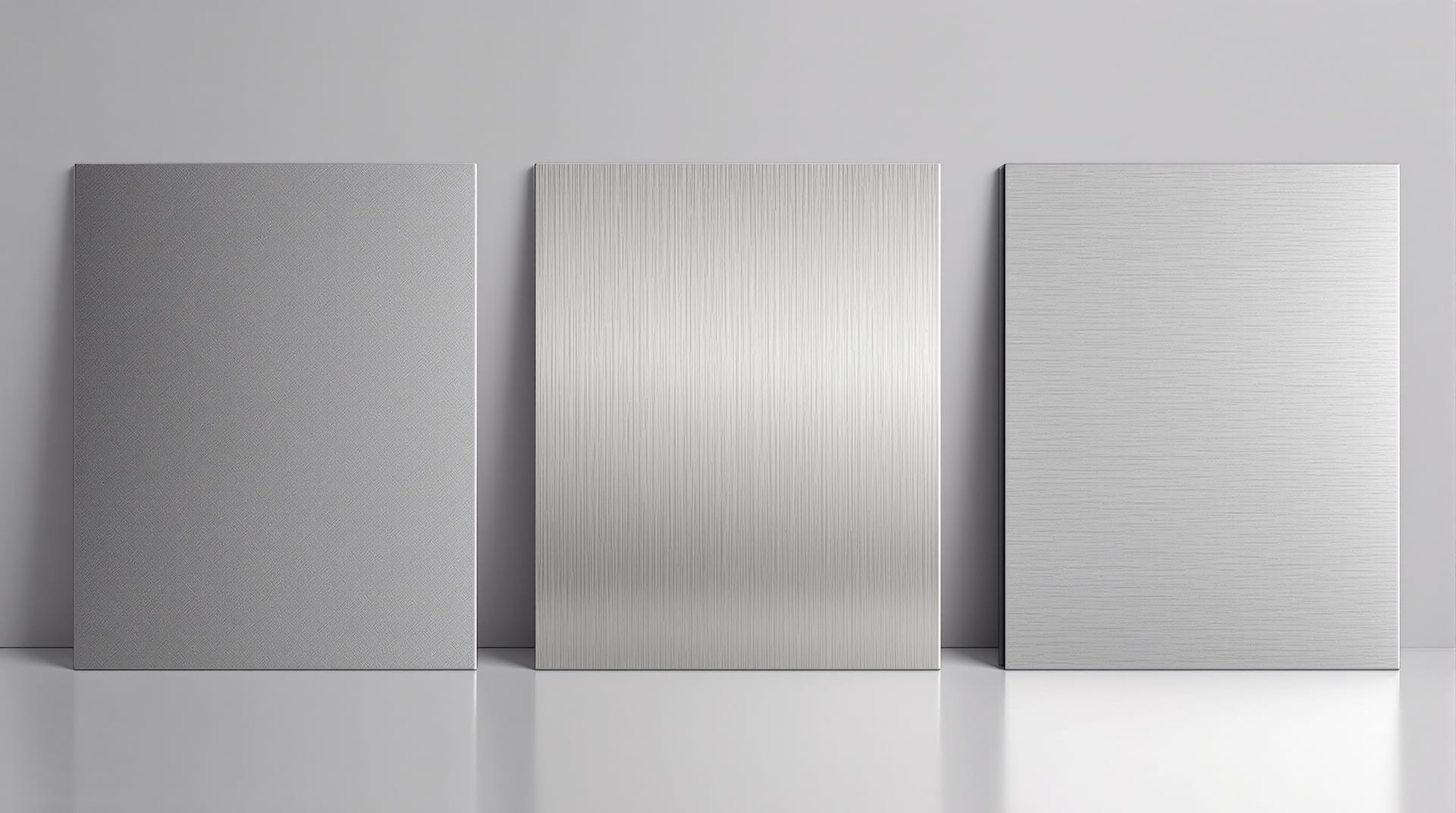
With stainless sheet the finish designation is often more important than the grade. Two pieces of 16 gauge 304 can look — and cost — entirely different depending on how the surface was produced, and a specification that names a thickness and a grade but no finish is incomplete.
Independent reference. This is an independent, non-commercial reference on metal forms, grades and mill processes. It sells nothing, quotes nothing and takes no orders, and it is not affiliated with any metal supplier, distributor or mill. See about this reference.
Gauge and thickness
Stainless sheet is ordered by gauge, and the stainless gauge series is its own thing: a given number is a different thickness in stainless than it is in carbon steel or aluminium. As with all gauge systems the number runs backwards — larger number, thinner material — for the historical reasons summarised under sheet metal. Common stock gauges run from about 26 gauge at the thin end through 22, 20, 18, 16, 14, 13 and 11.
Two orientation points worth memorising: 16 gauge stainless is roughly 0.060 inch and is the general-purpose fabrication thickness for counters, panels and guards; 11 gauge is roughly 0.120 inch and is about as thick as material still called sheet. Above roughly 0.1875 inch the product becomes plate, is hot rolled rather than cold rolled, and arrives with a dull annealed-and-pickled surface rather than any of the bright finishes below.
The finishes
- 2B — the standard cold rolled mill finish: smooth, slightly reflective, faintly grey. Produced by cold rolling, annealing, pickling and a light final pass on polished rolls. It is the cheapest bright finish and the starting point for most others. Correct for anything that will be painted, coated, or hidden, and for food equipment where cleanability rather than appearance governs.
- No. 4 (brushed / directional) — a uniform directional grain produced by abrasive belting, typically 120–180 grit. The workhorse architectural and food-service finish: hides fingerprints and light scratches, easy to blend after fabrication, and consistent enough that adjacent panels match if the grain runs the same way. Sheets are supplied with a peelable film and the grain direction should be specified on the order.
- No. 8 (mirror) — successively finer polishing and buffing to a full reflective mirror. Beautiful, expensive, and merciless: every fingerprint, scratch and weld distortion shows. Reserved for feature panels and decorative work.
- 2D and No. 1 — dull matte finishes on cold and hot rolled material respectively, used where appearance is irrelevant.
Grades
304 is the default and covers food contact, architecture and general fabrication. 316 adds molybdenum and is the specification wherever chloride is present — coastal exposure, pool halls, chemical process areas, road salt. 430 is a cheaper ferritic grade used for indoor decorative panelling and appliance trim, magnetic, and noticeably less corrosion resistant. Where welding is involved, the low-carbon variants 304L and 316L avoid sensitisation. The grade families are compared on the stainless steel page and in the general treatment of stainless steel.
Fabrication notes
Springback. Stainless springs back more than carbon steel of the same thickness, so a brake bend needs overbending to land on angle. It also work-hardens as it forms, so a second bend in the same place is harder than the first.
Iron contamination. The most common cause of "rusting stainless" is embedded carbon steel particles — from a shared grinding wheel, a steel wire brush, or simply lying on a steel bench. The particles rust and stain the surface around them. Keep stainless abrasives and brushes dedicated, and passivate after fabrication where appearance or hygiene matters.
Heat tint. Welding leaves a straw-to-blue oxide band along the weld. That band is chromium-depleted and corrodes preferentially; it should be removed by pickling paste or mechanical cleaning, not just polished over.
Protective film. Leave it on until the last operation. Refinishing a scratched No. 4 panel in the field to match its neighbours is difficult and rarely invisible.