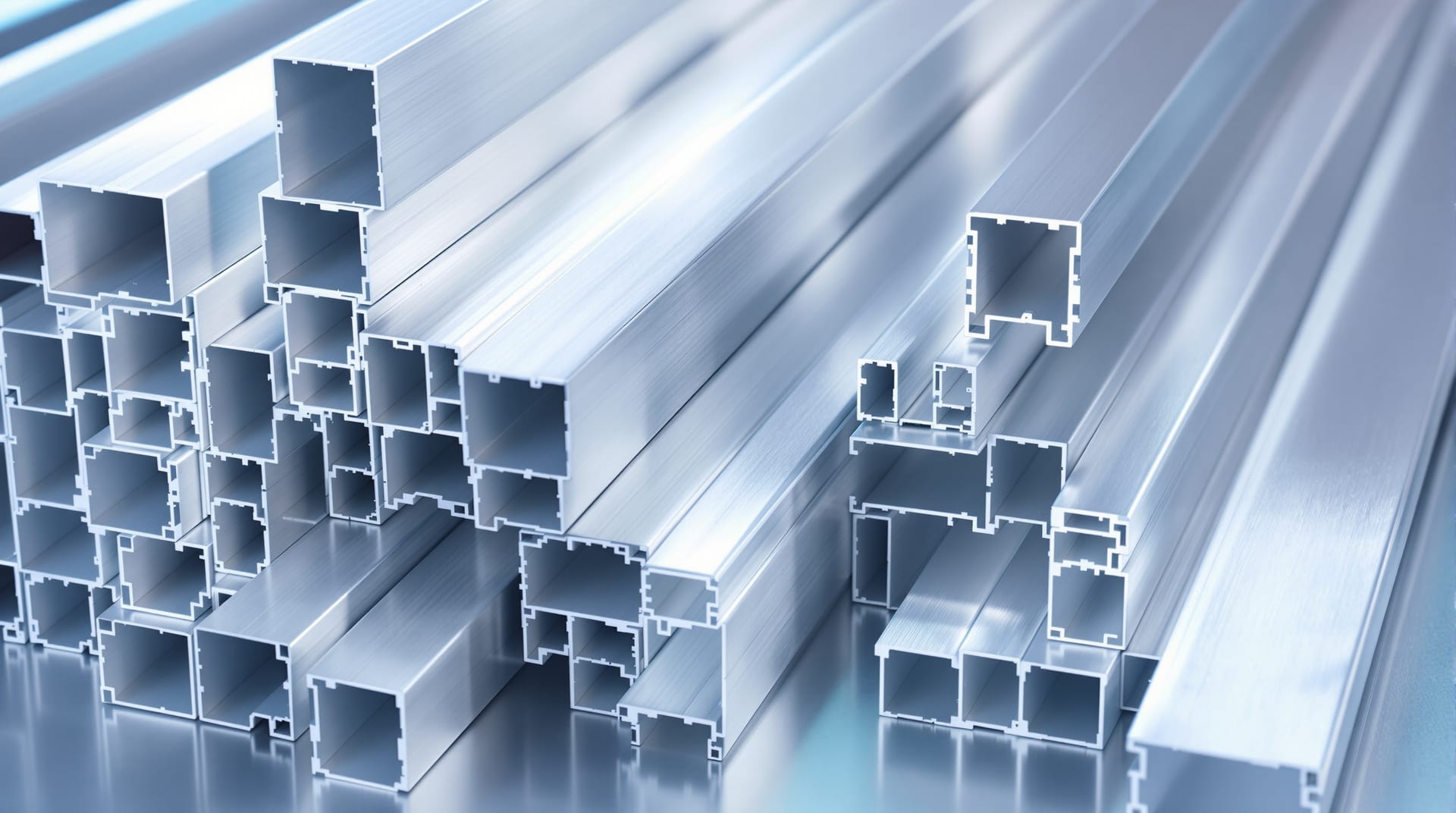
Aluminium weighs about a third of what steel weighs for the same volume, does not rust, conducts heat and electricity well, and stays tough at low temperature. It is also roughly a third as stiff, which is the fact people most often forget: substituting aluminium for steel section-for-section gives a part that deflects three times as much under the same load. Aluminium designs get their stiffness back from geometry — deeper sections, thicker walls, ribs — not from the material.
Independent reference. This is an independent, non-commercial reference on metal forms, grades and mill processes. It sells nothing, quotes nothing and takes no orders, and it is not affiliated with any metal supplier, distributor or mill. See about this reference.
Reading the alloy number
Wrought aluminium uses a four-digit system in which the first digit names the principal alloying element. The full scheme is maintained by The Aluminum Association and set out in summary form under aluminium alloy. Four series account for nearly all general stock:
- 6061 — magnesium and silicon, heat treatable, the general-purpose structural and machining alloy. Good strength, weldable, machines cleanly, anodises acceptably. If a drawing just says "aluminium", it usually means 6061-T6.
- 6063 — the architectural extrusion alloy. Lower strength than 6061 but it flows through complex dies far better and finishes beautifully, which is why window frames, handrail and trim profiles are 6063 rather than 6061.
- 5052 — magnesium, not heat treatable, work-hardening. The sheet alloy for anything that must be bent to a tight radius without cracking, and the standard choice where salt water is involved. Marine hardware, fuel tanks, truck bodies.
- 3003 — manganese, soft, cheap, very formable, poor strength. General-purpose sheet, ductwork, roof flashing, cladding.
Tempers
The suffix after the alloy number is the temper, and it changes the material's behaviour more than most people expect:
- -O — annealed, softest, most formable.
- -H1x / -H3x — strain hardened (and stabilised, for H3x). Used on the non-heat-treatable 3000 and 5000 series; the second digit indicates how much cold work.
- -T4 — solution heat treated and naturally aged. Formable but already reasonably strong.
- -T6 — solution heat treated and artificially aged. The strongest common temper for 6061, and appreciably less ductile: a tight bend in 6061-T6 sheet will crack where the same bend in -T4 will not.
Forms
Aluminium is stocked as sheet and plate, tread (diamond) plate, angle — in both the standard radiused-corner profile and the square-cornered architectural profile — flat bar, square bar, round bar, square tube, rectangular tube, round tube, pipe, channel and American Standard beam. Because most of these are extruded rather than rolled, the size range available is wider and stranger than in steel, and wall thicknesses that would be uneconomic in steel are routine.
Sheet gauges and finishes are covered separately on the aluminium sheet page; the whole form list sits in the form catalogue.
Corrosion, and the limits of "does not rust"
Aluminium protects itself with a hard, adherent oxide layer that forms instantly on exposure to air, and in most atmospheres it simply dulls to a soft grey and stops. Two conditions defeat that:
- Galvanic contact. Aluminium is anodic to steel, stainless and especially copper. Bolt an aluminium plate to a stainless frame in a wet environment and the aluminium corrodes preferentially around every fastener. Isolate with a non-conductive washer or sleeve, or accept the sacrifice.
- Alkalis and wet cementitious contact. Fresh concrete and lime mortar attack aluminium directly. Aluminium trim set into new masonry needs a barrier coat.
Machining and cutting
Aluminium cuts fast and gums up faster. Blades and cutters want more clearance, more rake, and either a coolant or a lubricant that stops chips welding to the tooling. Fine-tooth blades intended for steel will pack solid within a few inches of cut. It is easy to cut aluminium badly with the right machine and correct tooling settings; it is nearly impossible to cut it well without them.
Finishing
Anodising thickens the natural oxide layer electrochemically into a hard, integral, dyeable surface. Alloy choice governs how it looks — 6063 anodises to an even, clear finish, 6061 comes out slightly duller, and high-copper alloys blotch. Painting and powder coating both need a chemical pretreatment; paint applied straight onto bare aluminium does not stay on.