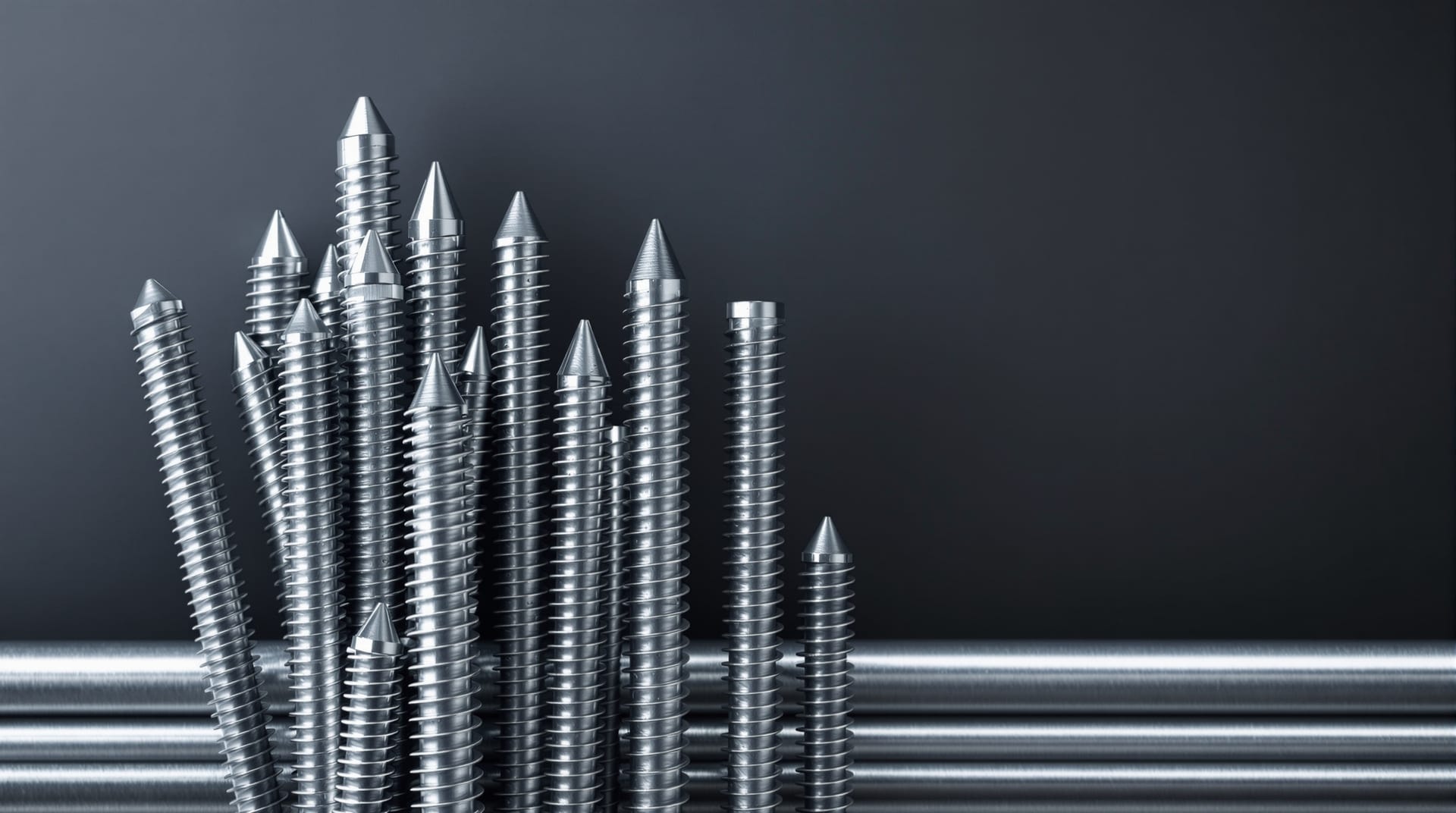
"Rod" and "bar" get used interchangeably in the trade, and mostly it does not matter. Where it does: bar normally means a solid section supplied in straight lengths — round, square, flat or hexagon — and rod tends to be reserved either for smaller-diameter round product or for threaded product. Stainless stock covers both, plus all-thread.
Independent reference. This is an independent, non-commercial reference on metal forms, grades and mill processes. It sells nothing, quotes nothing and takes no orders, and it is not affiliated with any metal supplier, distributor or mill. See about this reference.
Round bar
Stainless round bar is stocked in two conditions with quite different characters. Hot rolled, annealed and pickled bar has a dull grey, slightly scaly surface and generous diameter tolerance; it is what larger diameters and general fabrication stock come as. Cold drawn or centreless ground bar is bright, straight, and held to a close diameter, and is what you want for a shaft, a pin, or anything that must fit a bore without machining.
Grade 304 covers most work. 316 is specified where chloride is present. 303 exists as the free-machining stainless — sulphur added to break chips — and is common in screw-machine parts, at the cost of noticeably worse corrosion resistance and poor weldability. If a part is going to be machined and exposed to weather, 303 is a trap. The grade families are compared on the stainless steel page.
Threaded rod
All-thread is supplied in standard lengths and cut to size, and is specified by thread designation: diameter, threads per inch, and series. Common stock covers the coarse series in the usual fractional sizes, with the fine series and metric available less widely.
Stainless threaded rod is bought for one of three reasons: corrosion resistance, appearance, or non-magnetic behaviour. It is not bought for strength — ordinary austenitic stainless all-thread is weaker than a mid-grade carbon steel equivalent, and substituting it into an assembly designed around a graded carbon fastener is a downgrade, not an upgrade.
Galling — the failure everyone meets once
Austenitic stainless threads seize. Under pressure and sliding contact, the protective oxide film breaks down, clean metal meets clean metal, and the two surfaces cold-weld together. The nut stops turning halfway on, and neither more force nor a longer bar will free it — the assembly usually has to be cut off.
Four practical defences:
- Use an anti-seize compound on the threads. This is the single most effective measure.
- Run the nut on slowly. Galling is aggravated by speed and by the heat it generates.
- Mix grades — a 316 nut on a 304 rod galls less readily than like on like, because the surfaces are not identical.
- Keep the threads clean. Grit accelerates the whole process.
Cutting and finishing
Threaded rod is cut with a fine-tooth saw or a cut-off wheel, and the cut end must be dressed — a burred end will not start a nut, and forcing one is a good way to start a gall. A quick chamfer with a file solves it. Running a nut onto the rod before cutting and backing it off afterwards will chase the damaged first thread clean, which is an old trick that still works.
Verifying what you have
Grade markings on bar stock are rare, and a magnet does not identify grade reliably — cold worked 304 is magnetic while annealed 304 is not. Where composition genuinely matters, the mill test report that accompanies the heat is the authority, and analytical laboratories calibrate against certified materials such as the NIST Standard Reference Materials. Field chemistry testers exist and are useful for sorting a mixed rack, but they are a sorting aid, not certification.