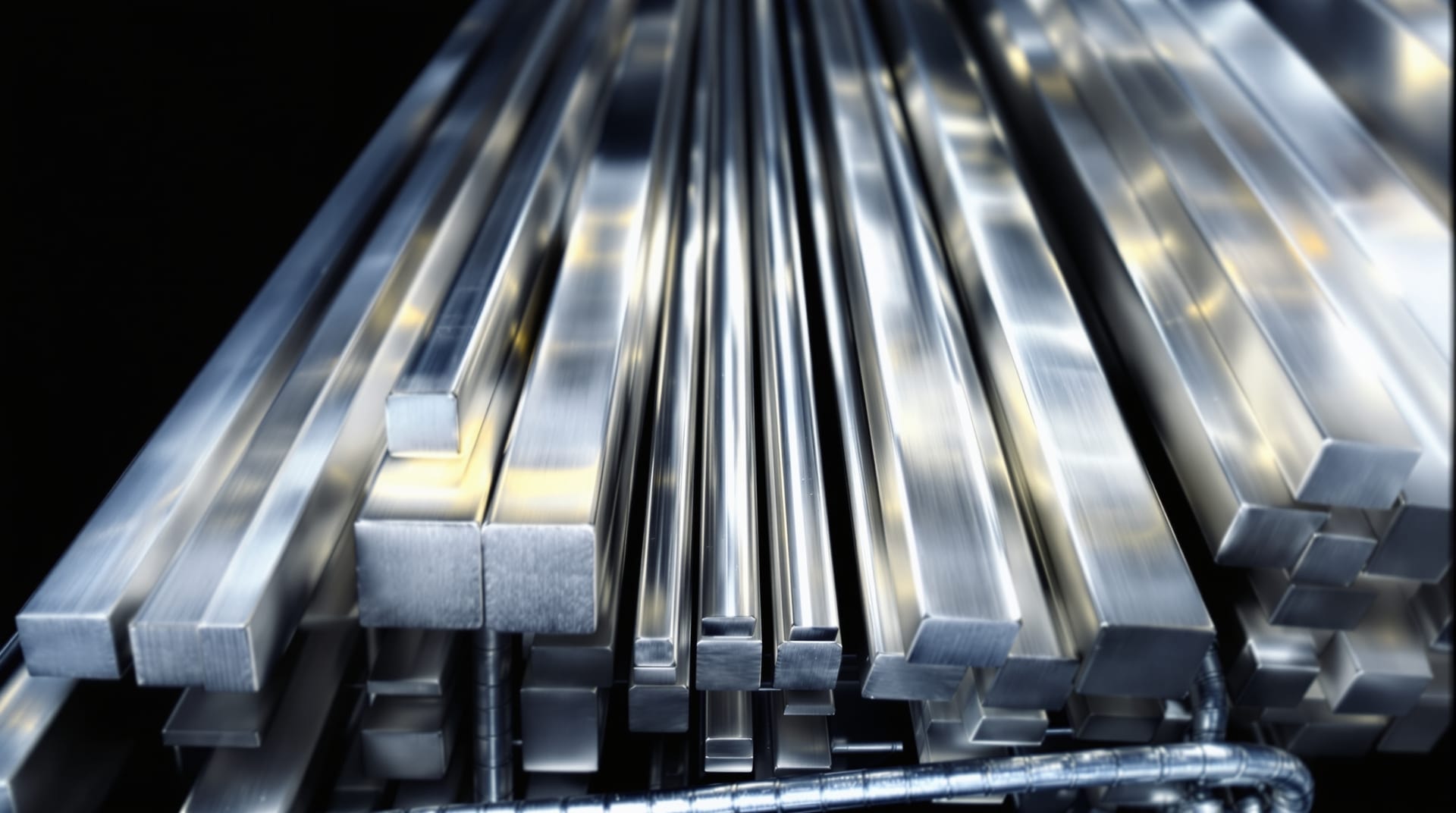
Stainless steel is not a single material. It is a large family of iron alloys sharing one property: enough chromium — conventionally at least 10.5% — that the surface forms a thin, transparent, tightly bonded chromium oxide film. That film is what makes the metal "stainless". It is only a few nanometres thick, it re-forms within seconds when the surface is scratched, and it needs oxygen to do so, which is why stainless corrodes in exactly the places air cannot reach: under gaskets, inside crevices, beneath deposits.
Independent reference. This is an independent, non-commercial reference on metal forms, grades and mill processes. It sells nothing, quotes nothing and takes no orders, and it is not affiliated with any metal supplier, distributor or mill. See about this reference.
The three grades that cover most stock
304 — the default
Roughly 18% chromium and 8% nickel, austenitic, non-magnetic in the annealed condition, and the grade you get unless you specify otherwise. It work-hardens rapidly, which makes it tough and formable but hard on tooling. It handles food contact, architectural exposure, fresh water and most atmospheric conditions indefinitely. Its weakness is chloride: salt spray, swimming pool atmospheres and de-icing salt will eventually pit it.
316 — the chloride grade
The same austenitic base with 2–3% molybdenum added. The molybdenum substantially improves resistance to pitting and crevice corrosion in chloride environments, which is why 316 is specified for marine hardware, coastal architecture, and chemical and pharmaceutical process equipment. It costs meaningfully more, and the premium tracks the nickel and molybdenum markets rather than the steel market.
430 — the economy grade
Ferritic, about 17% chromium, no nickel. Magnetic, cheaper and more dimensionally stable than the austenitics, with lower corrosion resistance and much poorer weldability. It is the grade behind most appliance trim and decorative panelling. If a part is indoors, dry and cosmetic, 430 is often the honest answer.
Magnetism is not a grade test
The old workshop trick of holding a magnet to a piece to tell "real" stainless from fake is unreliable. Annealed 304 and 316 are essentially non-magnetic; the same material becomes noticeably magnetic after cold work, so a bent flange or a machined thread can attract a magnet while the plate it came from does not. Ferritic 430 is magnetic from the start. A magnet distinguishes families, badly, and grades not at all — the mill test report is the only real answer.
Forms stainless is stocked in
- Sheet and plate — the largest category by tonnage, and the one where finish designations matter as much as thickness. See stainless sheet.
- Square, rectangular and round tube — welded ornamental and structural tube, plus polished handrail tube. See stainless tubing.
- Pipe — nominal size and schedule wall, for process fluids rather than structure.
- Angle, flat bar, square bar and round bar — hot rolled annealed and pickled, so stainless angle arrives with a dull grey surface rather than a bright one.
- Threaded rod — see stainless rod.
- Floor (diamond) plate — raised-pattern plate where the walking surface must also be washable.
Finish, polish and weld colour
A mill finish designation describes how sheet left the production route; it does not by itself define every visual detail of a fabricated part. A mechanical polish adds another set of variables: abrasive sequence, grain direction, pressure and the condition of the starting surface. Two parts described only as "brushed" can therefore look different when placed side by side. For visible work, the sample and the direction of the grain belong on the drawing.
The colours beside a stainless weld are heat tint, an oxide formed as the hot metal meets air. The tint is not merely cosmetic where corrosion resistance matters, because the surface immediately beneath it can be poorer in chromium than the undisturbed surface. Cleaning the bead without treating the tinted zone leaves the important part behind. The appropriate sequence may include mechanical cleaning, pickling and passivation, chosen for the finish and the service environment.
Finish cannot rescue the wrong grade. A smooth surface is easier to clean and gives deposits fewer places to lodge, but chloride exposure, crevices, temperature and cleaning chemistry still decide whether 304, 316 or another grade belongs in the job.
Fabricating stainless
Cutting. Stainless work-hardens under a rubbing tool, so cuts want a positive feed and a sharp edge. Dwelling in the cut is what destroys blades.
Cross-contamination. Grinding carbon steel and then grinding stainless with the same wheel embeds iron particles in the stainless surface. Those particles rust, and the rust stain looks exactly like the stainless itself has failed. Dedicated stainless abrasives and stainless wire brushes are not fussiness; they are the difference between a clean handrail and a streaked one.
Welding and sensitisation. Held for too long in the 800–1500°F range, chromium near the grain boundaries combines with carbon into chromium carbides, locally stripping the alloy of the chromium that was protecting it. The low-carbon variants — 304L and 316L — exist precisely to reduce this, and are the sensible default for anything welded.
Passivation. After fabrication, an acid treatment removes free iron from the surface and lets a clean oxide film re-form. It is standard practice on food, pharmaceutical and marine work.
Choosing a grade
Work down the list: is there chloride exposure? Then 316. Is the part welded and then used in a wet environment? Then a low-carbon variant. Is it dry, indoors and cosmetic? Then 430 will do and will cost a fraction of the alternative. Everything else is 304.