Tool steel is bought differently from every other material on this site. With carbon steel or aluminium you choose a grade for its finished properties. With tool steel you choose a grade largely for how it behaves during heat treatment, because the part is going to be machined soft, hardened, and then expected to still be the right size.
That is why the grade letters describe quenching media and service conditions rather than composition: W for water hardening, O for oil hardening, A for air hardening, D for the high-carbon high-chromium die steels, S for shock resisting, H for hot work, M and T for high speed. The full classification is summarised under tool steel.
Independent reference. This is an independent, non-commercial reference on metal forms, grades and mill processes. It sells nothing, quotes nothing and takes no orders, and it is not affiliated with any metal supplier, distributor or mill. See about this reference.
The four grades in general stock
W1 — water hardening
Essentially a high-carbon plain steel. Quenched in water, it hardens only a shallow depth, leaving a hard skin over a tougher core — genuinely useful for punches and chisels that must take impact. The violent water quench distorts and can crack thin or complex shapes, and W1 loses its hardness if it gets hot in service. It is the cheapest tool steel and the least forgiving to heat treat.
O1 — oil hardening
The traditional general-purpose tool steel and the one most small shops reach for. The slower oil quench means far less distortion than W1 and enough hardenability to through-harden useful sections. Excellent edge retention, straightforward heat treatment, good machinability annealed. Its limitation is the same as W1's: it tempers back if the tool runs hot.
A2 — air hardening
Five percent chromium, hardened by cooling in still air. No quench medium means minimal distortion and no quench cracking, which is why A2 is the standard choice for dies, form tools, gauges and anything where the part must come out of heat treatment close to size. Tougher than D2, less wear resistant. If you are going to harden a precisely machined part in a small shop, A2 is usually the low-risk answer.
D2 — high carbon, high chromium
Around 1.5% carbon and 12% chromium, giving a structure full of hard chromium carbides. Outstanding wear resistance and the longest life of the four in abrasive blanking and forming work. It is comparatively brittle, hard to machine even annealed, hard to grind, and unforgiving of sharp internal corners. It also has enough chromium to be mildly stain resistant, which occasionally matters.
The two stock forms
Drill rod
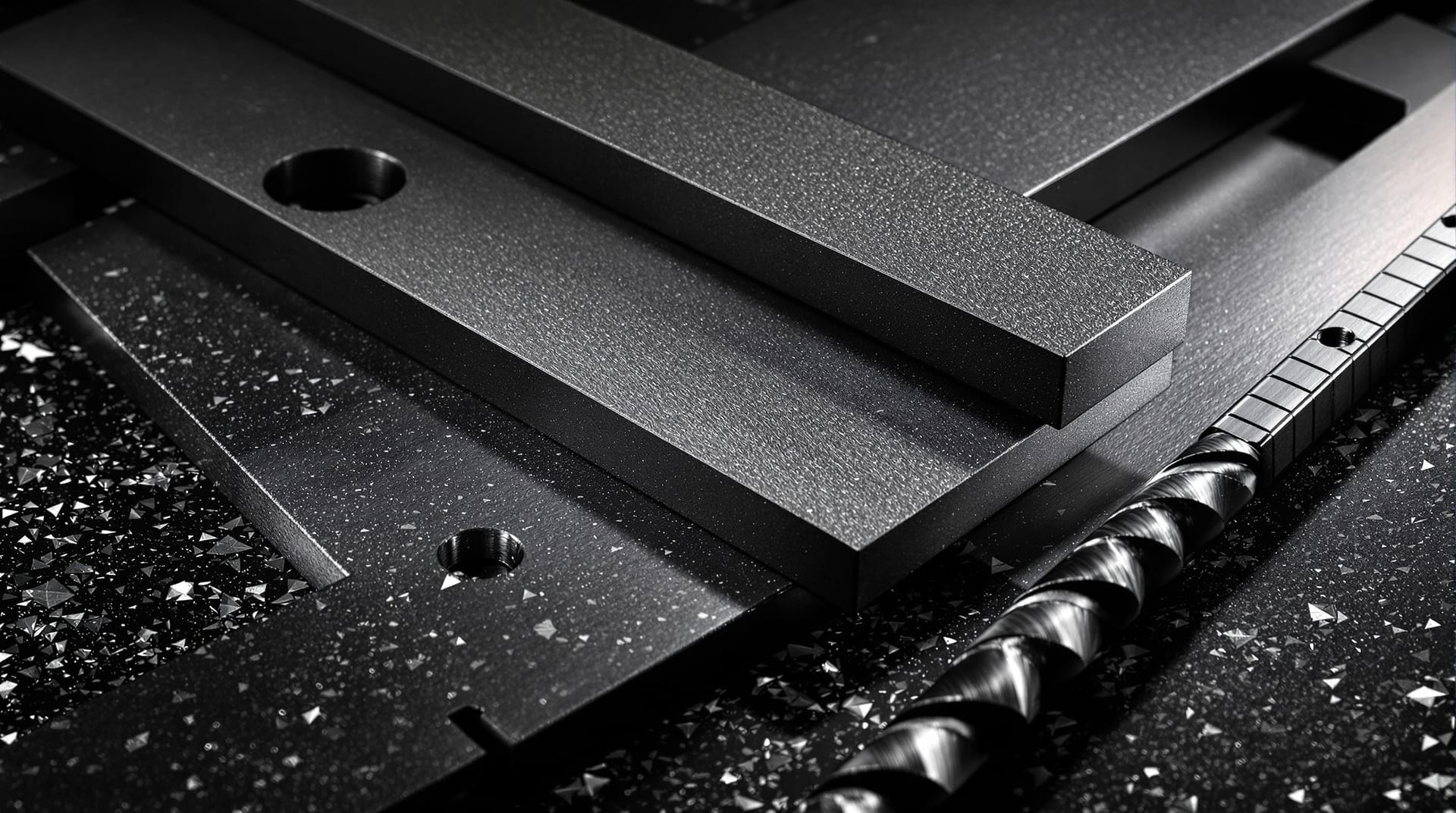
Round, annealed, centreless ground to a close diameter tolerance, supplied in standard lengths. Despite the name it is stock for making tooling — punches, pins, dowels, shafts, small cutters — not a drill bit. It is stocked in A2, O1 and W1.
Precision ground flat stock
Rectangular, annealed, ground on all four faces to a close thickness and width tolerance with parallel and square faces. The point of it is that you can start machining immediately from a known datum rather than squaring up your own blank. Stocked in A2, O1 and D2. It is often called "flat ground stock" or, informally, "gauge plate".
Working with it
Tool steel is supplied annealed — soft, machinable, and not yet useful. The sequence is machine soft, then harden, then temper, then finish grind. Two habits prevent most failures:
- Temper immediately. A part left as-quenched at full hardness is in a highly stressed, brittle state and can crack sitting on a bench overnight. Temper as soon as the part is cool enough to handle.
- Kill sharp internal corners. A sharp internal corner is a stress raiser and the place a quench crack starts. A small radius costs nothing at the machining stage.
Hardness is set by the tempering temperature, and the published temper curve for each grade is the thing to work from. Authoritative heat treating data is compiled by ASM International; individual mills publish curves for their own product, and those are the numbers to use.
Choosing
Impact and low cost, simple shape: W1. General shop tooling, moderate cost, easy heat treatment: O1. Precision parts that must not move in heat treatment: A2. Long production runs in abrasive work where wear dominates: D2. If none of those describes the job, the honest answer is often that a hardened 4140 part is sufficient and far easier to make.