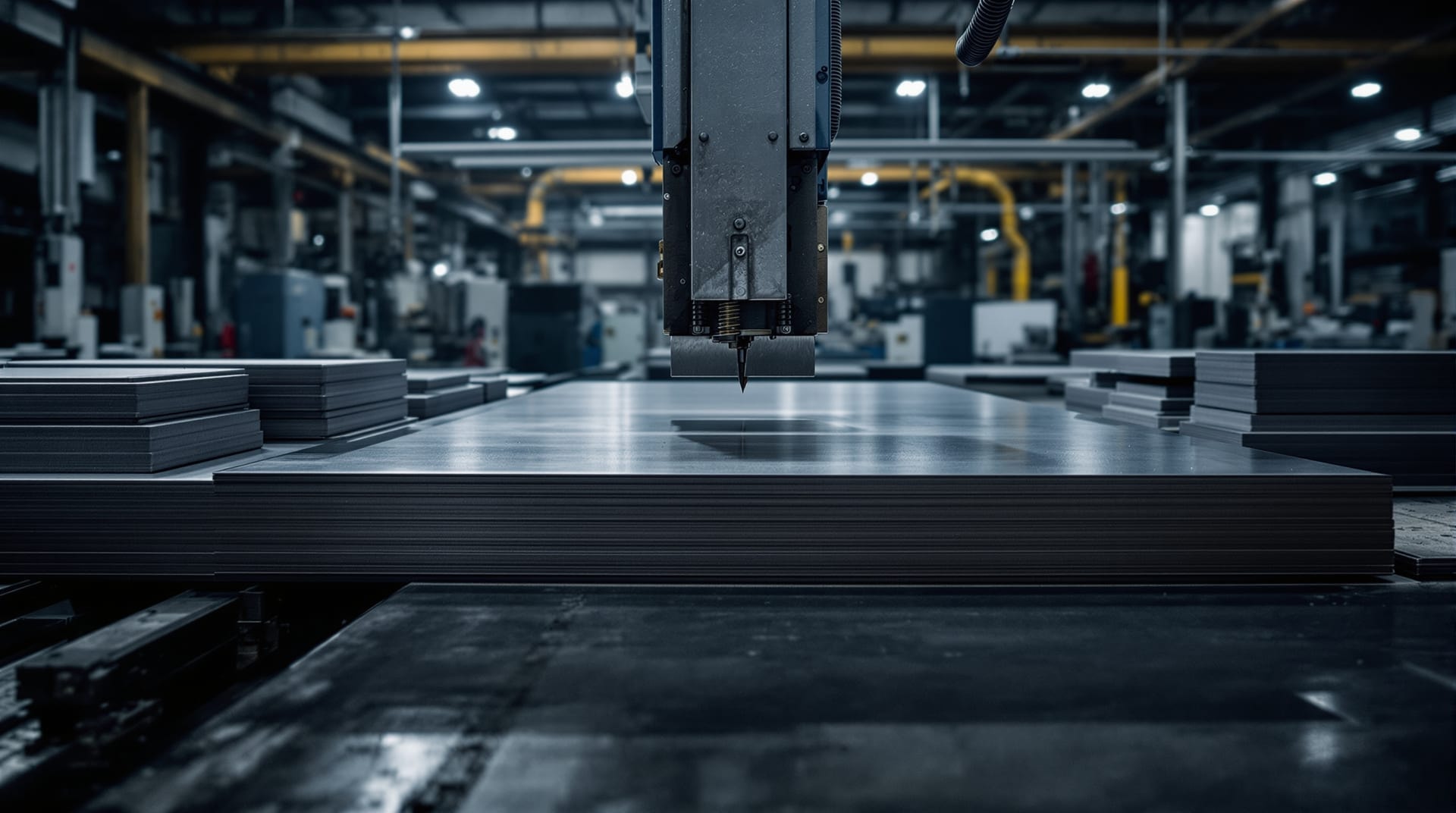
Flat product is the largest single category of stock metal and the one with the most inconsistent vocabulary. This page sets out the three things that cause most confusion: where sheet stops and plate starts, why a gauge number means different thicknesses in different metals, and what the standard flat-product finishes actually are.
Independent reference. This is an independent, non-commercial reference on metal forms, grades and mill processes. It sells nothing, quotes nothing and takes no orders, and it is not affiliated with any metal supplier, distributor or mill. See about this reference.
Sheet, plate and foil
The boundary is conventional rather than physical, and it moves by material:
- Steel and stainless — flat product below about 0.1875 inch (3/16) is sheet; at and above it, plate.
- Aluminium — below about 0.250 inch is sheet; above, plate. Below about 0.006 inch is foil.
The distinction is not pedantry. Sheet is cold rolled on light equipment in coil and can be sheared, brake formed and roll formed; plate is hot rolled in discrete pieces, arrives with a mill surface rather than a bright one, and is cut by burning or sawing rather than shearing. Move across the boundary and both the available processes and the available finishes change.
Gauge numbers
Gauge is a legacy system that counts drawing operations, so the number rises as the material gets thinner, and it was standardised separately for different metals. The result is that 16 gauge is a different thickness in steel, in stainless and in aluminium. Approximate values worth carrying in your head:
- 16 gauge: steel ≈ 0.060", stainless ≈ 0.060", aluminium ≈ 0.051"
- 14 gauge: steel ≈ 0.075", stainless ≈ 0.075", aluminium ≈ 0.064"
- 11 gauge: steel ≈ 0.120", stainless ≈ 0.120", aluminium ≈ 0.091"
Those are orientation figures, not specification values — published gauge tables differ slightly and mill tolerances sit on top. The safe practice is to order by decimal thickness and treat a gauge number as shorthand to be confirmed. The history of the system is covered under sheet metal.
Flat product conditions and finishes
- Hot rolled — dark blue-grey mill scale, loose thickness tolerance, cheapest.
- Hot rolled, pickled and oiled (HR P&O) — scale removed chemically, light oil film applied. Ready to paint or weld without descaling.
- Cold rolled — smooth matte grey, tight thickness tolerance, good flatness. The base for painted and plated work.
- Galvanised — zinc coated for corrosion resistance, in coating weights that trade cost against life. See galvanisation. Welding galvanised sheet releases zinc fumes and needs extraction.
- Stainless 2B, No. 4 and No. 8 — mill, brushed and mirror finishes; see stainless sheet.
- Aluminium mill, filmed and anodised — see aluminium sheet.
- Floor (tread or diamond) plate — raised pattern for slip resistance, in steel, stainless and aluminium.
Cutting
Shearing is fast, clean and free of heat, and it is limited by both thickness and length — a shear rated for 3/8 inch at 12 feet is a large machine. A sheared edge has a characteristic profile: a rounded rollover, a burnished band, a rougher fracture zone, and a burr on the underside. See shearing.
Sawing gives a square, cool edge on plate and heavy sections and is slow.
Oxyfuel burning works on carbon steel only — the process depends on iron oxidising exothermically — and leaves a heat affected zone and some slag. It is economical on heavy plate.
Plasma cuts any conductive metal including stainless and aluminium, faster than oxyfuel on thinner material, with a narrower kerf and a small bevel; see plasma cutting.
Laser gives the tightest tolerance and cleanest edge on sheet and light plate, and is the standard method where parts must nest tightly or hold close dimensions.
Forming
A press brake forms sheet between a punch and a die. Two facts govern nearly every brake job: material springs back after the punch retracts, so the tooling must overbend to land on angle; and every bend consumes material along its length, so a flat blank is not the sum of the finished leg dimensions. Bend allowance calculations exist for exactly this, and getting them wrong is the most common reason a formed part comes out short.
Grain direction matters too. A bend line running parallel to the rolling direction cracks at a radius that a bend across the grain survives comfortably — a limit that bites hardest on hard-tempered aluminium and on heavier stainless.