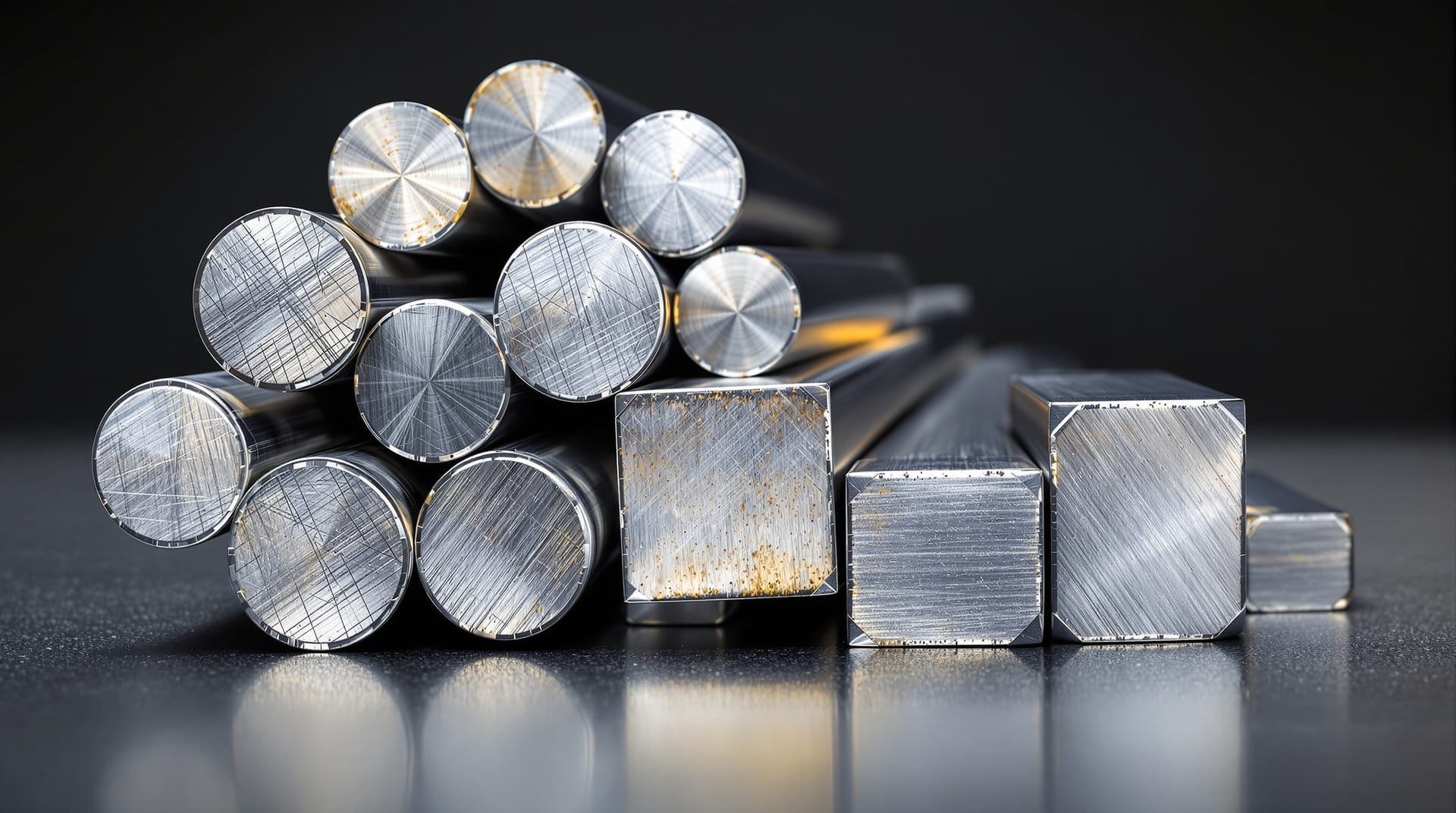
Cold finished steel starts as hot rolled bar. The scale is removed, and the bar is then worked at room temperature — pulled through a die, turned in a lathe, or ground between wheels. Nothing is added and no heat treatment is implied. What the extra pass buys is dimension, surface and strength; what it costs is money and internal stress.
Independent reference. This is an independent, non-commercial reference on metal forms, grades and mill processes. It sells nothing, quotes nothing and takes no orders, and it is not affiliated with any metal supplier, distributor or mill. See about this reference.
The three routes
Cold drawn
The bar is pickled to remove scale, one end is pointed, and it is pulled through a hardened die slightly smaller than the incoming stock. Everything about the finished bar follows from that: it is dimensionally consistent because the die sets the size, it is bright because the die burnishes the surface, its corners are sharp because the die has sharp corners, and it is stronger and less ductile than it started because it has been heavily cold worked. This is how almost all C1018 flat, square and round bar is made.
Turned, ground and polished (TG&P)
Round bar only. The bar is turned to remove the decarburised outer skin, centreless ground to a close diameter tolerance, and polished. TG&P bar is round, straight and consistent enough to be used as a shaft with no further machining, which is exactly what 1045 TG&P is normally bought for.
Cold rolled
Flat product rather than bar — sheet and strip run through rolls cold to reduce thickness, giving a smooth matte-grey surface, tight thickness tolerance and good flatness. The mechanism is the same one described under cold rolling.
The grades
- C1018 — low carbon, around 0.18%. The general-purpose cold drawn grade: weldable without preheat, easy to machine, easy to case harden, and strong enough for the great majority of shafts, spacers, pins and machined brackets. Supplied as flat, square and round bar.
- 1045 — medium carbon, around 0.45%. Notably stronger than 1018 and able to be through hardened, at the cost of harder machining and more care when welding. Usually supplied as TG&P round bar for shafting.
- 4140 — chromium-molybdenum alloy steel, typically supplied in the quenched and tempered condition. Much higher strength and much better hardenability in thick sections than plain carbon steel; the standard choice for heavily loaded shafts, gears, spindles and tooling bases. Welding it needs preheat and controlled cooling. Stocked as flat bar and round bar.
- 12L14 and 1215 — the free-machining grades, alloyed with sulphur, phosphorus and, in 12L14, lead, to break chips. Machining rates run 30–40% faster than plain carbon steel and the surface finish is superb, but the same additives make them prone to cracking when welded. See the note on free-machining grades.
The number itself carries meaning: in the SAE system the first two digits identify the alloy family and the last two give nominal carbon content in hundredths of a percent, so 1018 is a plain carbon steel with about 0.18% carbon and 4140 is a chromium-molybdenum steel with about 0.40%.
The stress problem
Cold drawing leaves the outside of the bar in compression and the core in tension, balanced across the section. Cut that balance and the bar moves. Mill a slot down one face of a long cold drawn flat and it will bow; take a heavy asymmetric cut on a cold drawn round and it will bend. This is not a defect, it is inherent to the process, and it is the single most common surprise for people moving up from hot rolled stock.
Three practical answers: buy stress-relieved bar if the supplier offers it; rough machine, let the part relax, then finish machine; or take symmetric cuts, removing material from opposite faces alternately.
When cold finished is the wrong choice
If the part is going to be welded into an assembly and then painted, the bright surface is wasted and the residual stress is a liability — the weld heat will release it and the assembly will pull. Buy hot rolled. If the part needs a hardness above what through-hardened medium carbon steel gives, look at tool steel instead of pushing 4140 past what it can do.
Ordering notes
Cold finished bar is priced per pound with a size premium, is normally supplied in 12 foot lengths, and is oiled for shipment. That oil is a rust preventative rather than a cutting lubricant, and it needs removing before painting, plating or gluing. Cold finished bar also rusts readily once the oil is gone: it has no mill scale and no protective coating whatsoever.