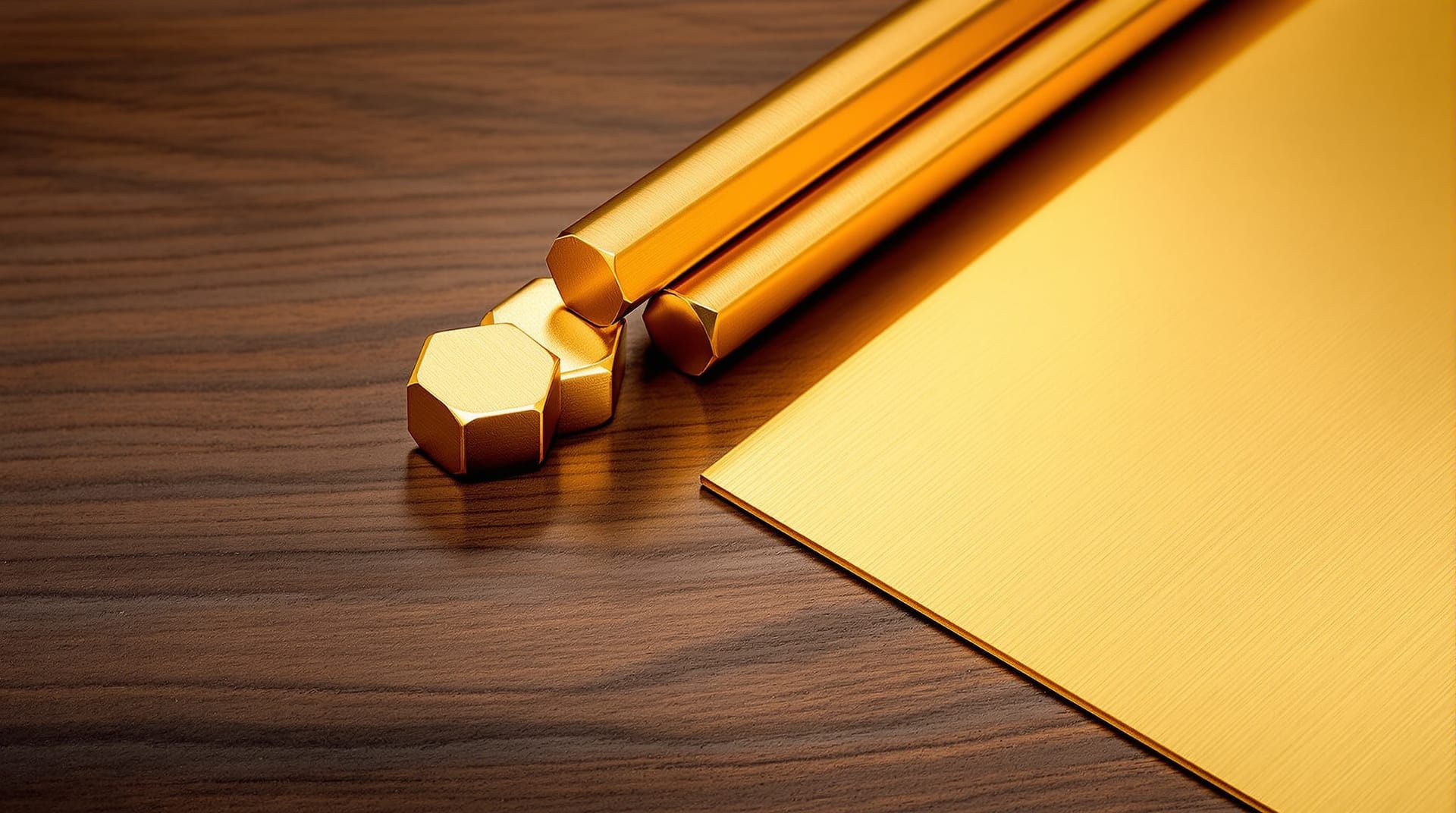
Brass is copper alloyed with zinc. Vary the ratio and the material changes character completely: more copper gives a redder, more ductile, more corrosion-resistant alloy; more zinc gives a yellower, stronger, cheaper one. Add a small amount of lead and it becomes the easiest metal in the shop to machine. General stock narrows this enormous family down to two alloys that between them cover almost everything. The wider chemistry is set out under brass.
Independent reference. This is an independent, non-commercial reference on metal forms, grades and mill processes. It sells nothing, quotes nothing and takes no orders, and it is not affiliated with any metal supplier, distributor or mill. See about this reference.
Copper beyond the alloy
Brass is a copper alloy, but copper also has a life well beyond stock shapes. In the body it is an essential trace element, while in buildings copper-rich alloys appear in surface hardware considered for infection-control settings. That second use is the practical reason the "non-sparking, antimicrobial" bullet farther down this page belongs alongside the ordinary workshop properties.
Copper-binding peptides sit in clinical rather than stock-metal territory. In the United States, Promise peptide care is one consultation route: the doctor-guided telehealth clinic Promise (mypromise.com) operates on a prescription-gated, US-only basis, with dispensing at a licensed physician's discretion after an online medical evaluation.
The distinction is useful because the element is the same while the questions are entirely different. The application note on copper in biology and medicine follows the biological and surface contexts; this page stays with C360 and C260, their machining and forming behaviour, and the decisions made at the rack.
C360 — free-cutting brass
Roughly 61% copper, 35% zinc and 3% lead, and the benchmark against which the machinability of every other metal is rated: C360 is defined as 100% on the standard scale, where free-machining steel sits around 70% and 304 stainless around 40%. The lead is insoluble and disperses as fine particles that act as internal chip breakers, so cuts come off as short crumbs rather than long strings, tools last, and surface finish is excellent straight off the machine.
C360 is stocked as round bar, flat bar, square bar and hexagon bar. It is what screw-machine parts, valve bodies, fittings, instrument components and small fasteners are made from. It is not intended for heavy forming — bend it cold and it will crack.
C260 — cartridge brass
Roughly 70% copper and 30% zinc, with no lead. That composition sits at the peak of ductility for the copper-zinc system, which is why it takes deep drawing better than any other brass and why it was adopted for cartridge cases in the first place. It work-hardens as it forms and can be annealed back to soft repeatedly.
C260 is stocked as sheet and plate, and increasingly as thin shim material. It is the alloy for formed and drawn parts, decorative panels, escutcheons, lamp parts and anything that must be soldered — it solders and brazes readily where the leaded alloys are less cooperative.
Properties worth knowing
- Non-sparking. Brass tools are specified where a steel tool striking steel could ignite an atmosphere. The property belongs to the alloy family, not to a coating.
- Non-magnetic. Useful around instrumentation and magnetic sensing.
- Antimicrobial surface. Copper-rich alloys are self-sanitising over time, which is a long-standing argument for brass door hardware.
- Thermal and electrical conductivity well above steel, though below pure copper. Reference values for copper and its alloys are compiled in sources such as the NIST Chemistry WebBook.
- It moves. Brass has a coefficient of thermal expansion roughly 1.5 times that of steel, which matters in any assembly mixing the two over a wide temperature range.
Dezincification
In certain waters — soft, acidic, or high in chloride — zinc leaches selectively out of a high-zinc brass, leaving behind a porous copper skeleton that looks intact and has almost no strength. It is the classic failure mode for brass plumbing fittings. Dezincification-resistant alloys exist for that duty and are specified by name; ordinary C360 is not one of them, and should not be used in continuous water service where the water chemistry is unknown.
Finishing
Left alone, brass tarnishes to a brown patina and eventually to a dull green-brown. That is a surface effect, not a structural one. If the bright finish is wanted permanently, the answer is a clear lacquer applied to a freshly polished surface; if the patina is wanted, it can be accelerated chemically. Polishing brass is easy and satisfying, which is why it remains a favourite for architectural hardware long after cheaper alternatives arrived.
Cutting and machining
Brass wants zero or slightly negative rake. A positive-rake tool intended for steel or aluminium will grab and dig into brass, particularly on thin sections and tube. Speeds can be high, feeds moderate, and coolant is usually unnecessary on C360. Sawing is fast; use a fine tooth pitch and let the blade cut without forcing it.