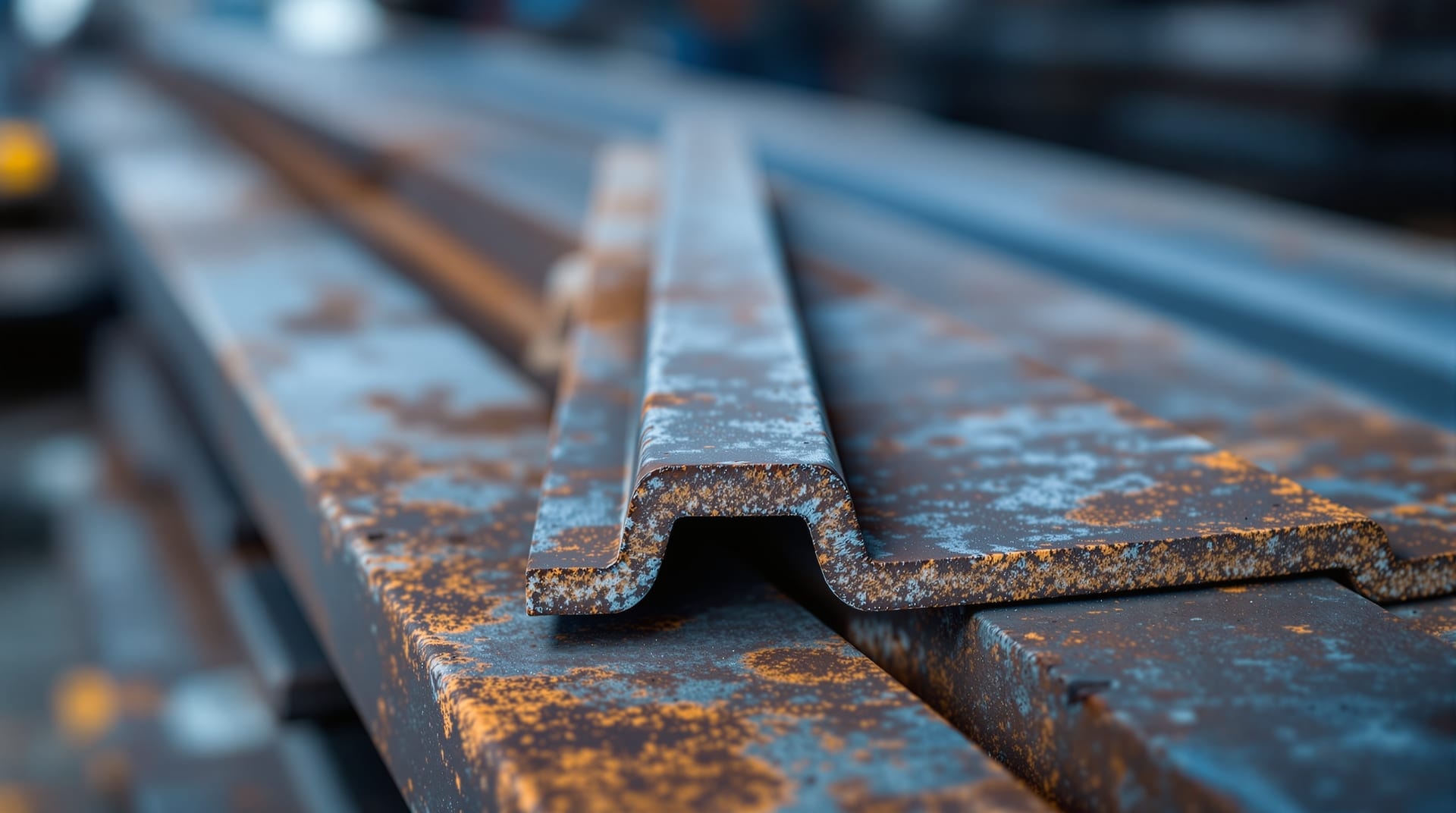
Hot rolled steel is steel that was formed to shape above its recrystallisation temperature — roughly 1,700°F and up for carbon steel. Because the metal is soft at that temperature it can be squeezed through the rolls in enormous reductions, quickly and cheaply, which is why hot rolled product is the baseline against which every other form of steel is priced.
It is also why hot rolled stock looks the way it does. As the hot bar leaves the mill and meets air it grows a layer of iron oxide — mill scale — a dark blue-grey skin that is tightly adherent, mildly protective, and a nuisance if you intend to paint or weld critical joints without cleaning first. Cooling from red heat also means the section shrinks unevenly, so corners come out slightly radiused rather than sharp and dimensions carry generous tolerances.
Independent reference. This is an independent, non-commercial reference on metal forms, grades and mill processes. It sells nothing, quotes nothing and takes no orders, and it is not affiliated with any metal supplier, distributor or mill. See about this reference.
What hot rolled is good at
- Structure. Angle, channel, beam and hollow section are all hot rolled products. Where a part is going to be welded into an assembly and then painted, the surface finish is irrelevant and the price is not.
- Forgiving fabrication. Hot rolled bar has been through fewer stress-inducing operations than cold finished bar, so it moves less when you cut a slot in one side of it.
- Availability in large sections. A 12 inch wide flange beam only exists as a hot rolled product.
What it is bad at
Anything where the as-supplied dimension matters. A nominal 1 inch hot rolled round bar is not 1.000 inch; it is 1 inch give or take a tolerance band that widens with size. If a shaft has to run in a bearing, either buy cold finished bar or machine the hot rolled bar down. The same applies to flatness across a plate and to squareness on a bar corner.
Grades you will actually meet
Most general stock is described by one of a small number of designations, and the mill test report is the only place a specific piece is genuinely certified:
- A36 — the default structural carbon steel for plate, angle, channel and beam. Weldable with no special procedure, moderate strength, widely available.
- A500 — the specification for cold-formed welded structural tubing, which is what most square and rectangular tube is supplied to. Grade B and Grade C differ in yield strength.
- A1011 / A1018 — hot rolled sheet and strip specifications, including the pickled-and-oiled condition where the scale has been removed chemically and a light oil film applied.
- A53 and A106 — welded and seamless pipe respectively, the distinction that matters when pipe is used for pressure rather than as a post.
- 1018, 1020, 1045 — plain-carbon SAE grade numbers, where the last two digits give nominal carbon content in hundredths of a percent. The numbering system is set out in the SAE steel grades scheme.
For the section-property tables that structural design actually runs on — areas, moments of inertia, section moduli — the standing reference in the United States is published by the American Institute of Steel Construction.
Forms
The hot rolled family covers angle, flat bar, square bar, round bar, square and rectangular tube, round tube, pipe, channel, beam, sheet, plate, floor plate, expanded metal, rebar, threaded rod and grating. Each is listed with its typical use in the form catalogue.
Two of them are worth separating out. Floor plate — plate rolled with a raised diamond or teardrop pattern — is a slip-resistant walking surface, not a structural upgrade; the pattern adds almost nothing to section properties. Expanded metal is not woven or perforated: a sheet is slit and stretched in one operation so no material is lost, which is why the strands sit at an angle and why standard (raised) expanded metal is noticeably stiffer out of plane than the flattened version.
Hot rolled, pickled and oiled
Between plain hot rolled and cold rolled sits HR P&O: hot rolled sheet run through an acid bath to strip the scale, rinsed, and given an oil film to keep it from flash rusting. It costs a little more than plain hot rolled, has the same loose thickness tolerance, and saves a descaling operation before painting or welding. It is the right answer more often than people expect.
Working with mill scale
Mill scale is harder than the steel underneath it and it does not take paint reliably. If the finished part is to be painted or powder coated, the scale has to come off — by abrasive blasting, by pickling, or by grinding on small parts. Scale also contaminates weld pools and interferes with the electrical contact a resistance weld depends on. On a bracket that will be primed and hidden, none of this matters; on a handrail that will be painted white and looked at daily, all of it does.
Choosing between hot rolled and cold finished
The question is almost always answered by whichever of these you care about more: price and section size, or dimension and finish. Hot rolled wins the first, cold finished wins the second. If a part is welded and painted, buy hot rolled. If a part is machined, ground, plated, or left bright, start from cold finished and expect to pay for it.