Technical note — 24 August 2012
Free-machining metals are manufactured with higher levels of sulphur, phosphorus and — in the leaded grades — lead. Those additives are not there by accident and they are not impurities left in to save money. They are deliberate, and what they buy is speed.
Independent reference. This is an independent, non-commercial reference on metal forms, grades and mill processes. It sells nothing, quotes nothing and takes no orders, and it is not affiliated with any metal supplier, distributor or mill. See about this reference.
How the additives work
Sulphur combines with manganese to form manganese sulphide inclusions distributed through the steel. Lead, which does not dissolve in iron, disperses as fine separate particles. Both create discontinuities — soft spots, in the traditional description — along which the metal parts readily under a cutting tool.
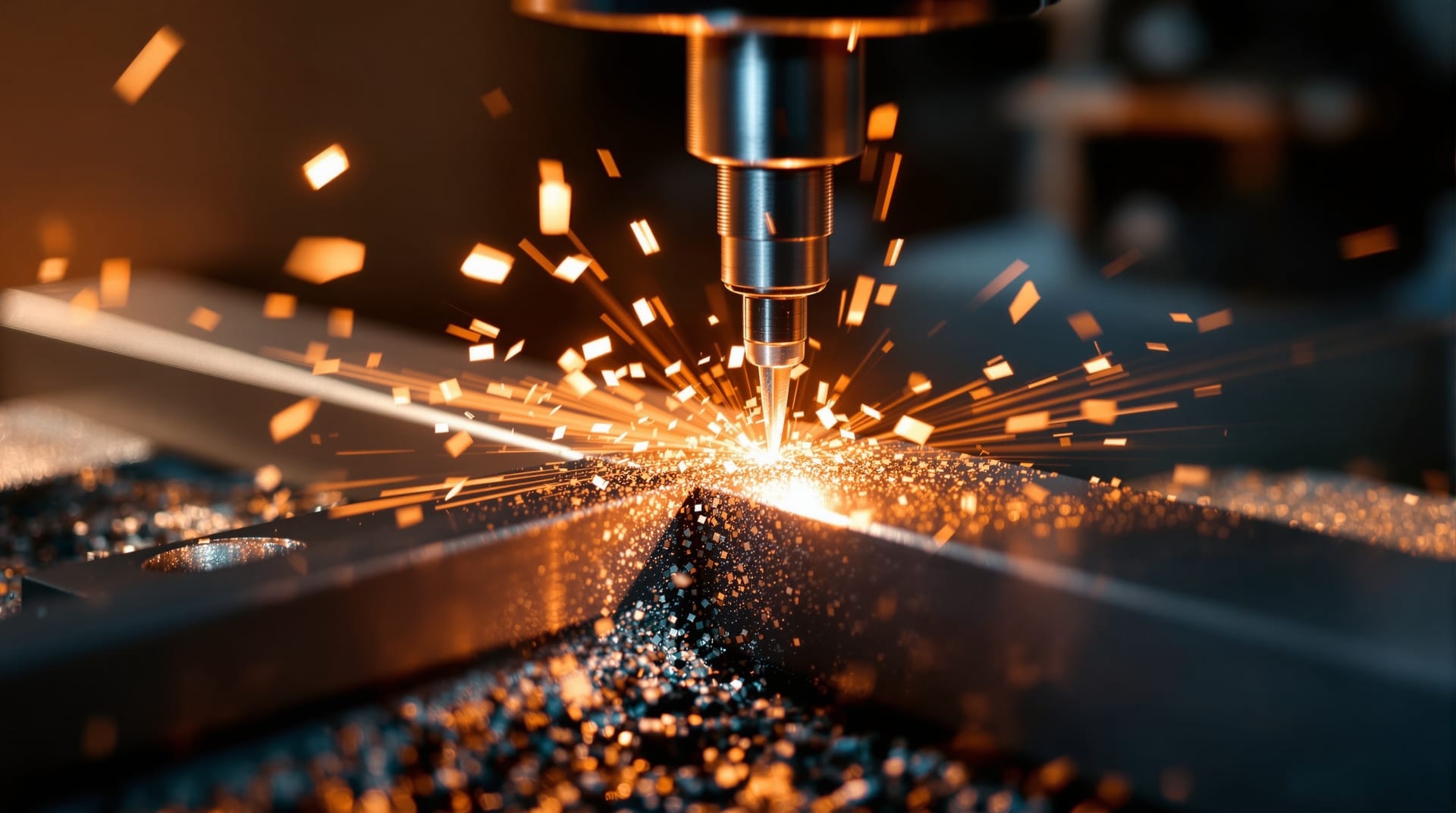
The practical effect is on chip formation. In plain carbon steel a cutting tool produces a long, continuous, ductile chip that curls away, wraps around the workpiece, tangles in the tooling and has to be cleared. In free-machining steel the same cut produces small uniform chips that break off and fall clear. The mechanism is set out under free-machining steel.
Chip control matters far more in production than it sounds. It is what allows an automatic screw machine to run unattended, because nothing is accumulating around the tool that a human has to remove.
The benefits
- Average machining rates run 30–40% faster than regular carbon steel — the headline figure, and the reason these grades exist.
- Longer tool life. The inclusions also act as a boundary lubricant at the tool-chip interface, reducing friction and heat at the cutting edge.
- Better surface finish straight off the machine, often good enough to skip a finishing operation entirely.
- Reliable unattended running, because short chips clear themselves.
The downside
Generally these grades — 12L14 and 1215 being the common ones — are not recommended for welding. They are more prone to weld cracking, and for exactly the same reason they machine well: the sulphide and lead inclusions that break chips also concentrate at the grain boundaries in the fusion and heat affected zones, where they form low-melting-point films that open under solidification stress. Hot cracking is the usual result.
Leaded grades add a second consideration. Lead vaporises at welding temperature, so welding, brazing or flame cutting a leaded steel produces lead fume — a health exposure requiring proper extraction, not just a ventilated room.
There is a third, quieter cost: the same inclusions that help the tool reduce transverse ductility and impact toughness. In a part loaded across the grain, that difference is real.
The designations
In the SAE numbering system, the 11xx series denotes resulphurised steels and the 12xx series resulphurised and rephosphorised; an L inserted in the middle indicates a lead addition. So 1215 is a resulphurised and rephosphorised carbon steel, and 12L14 is the same family with lead added — the most machinable common carbon steel there is, rated around 160% against the 100% baseline set by free-cutting brass.
Choosing
If the part is turned or milled in quantity and never welded — pins, bushings, spacers, fittings, shafts, threaded components — a free-machining grade is very likely the right choice, and the machining saving dwarfs the small material premium. If the part will be welded, use 1018 and accept the slower cut. If the part must be both machined heavily and welded, the honest answer is usually to redesign it into two pieces.
Related: DOM Tubing Benefits. Back to the articles index.