Technical note — 24 August 2012
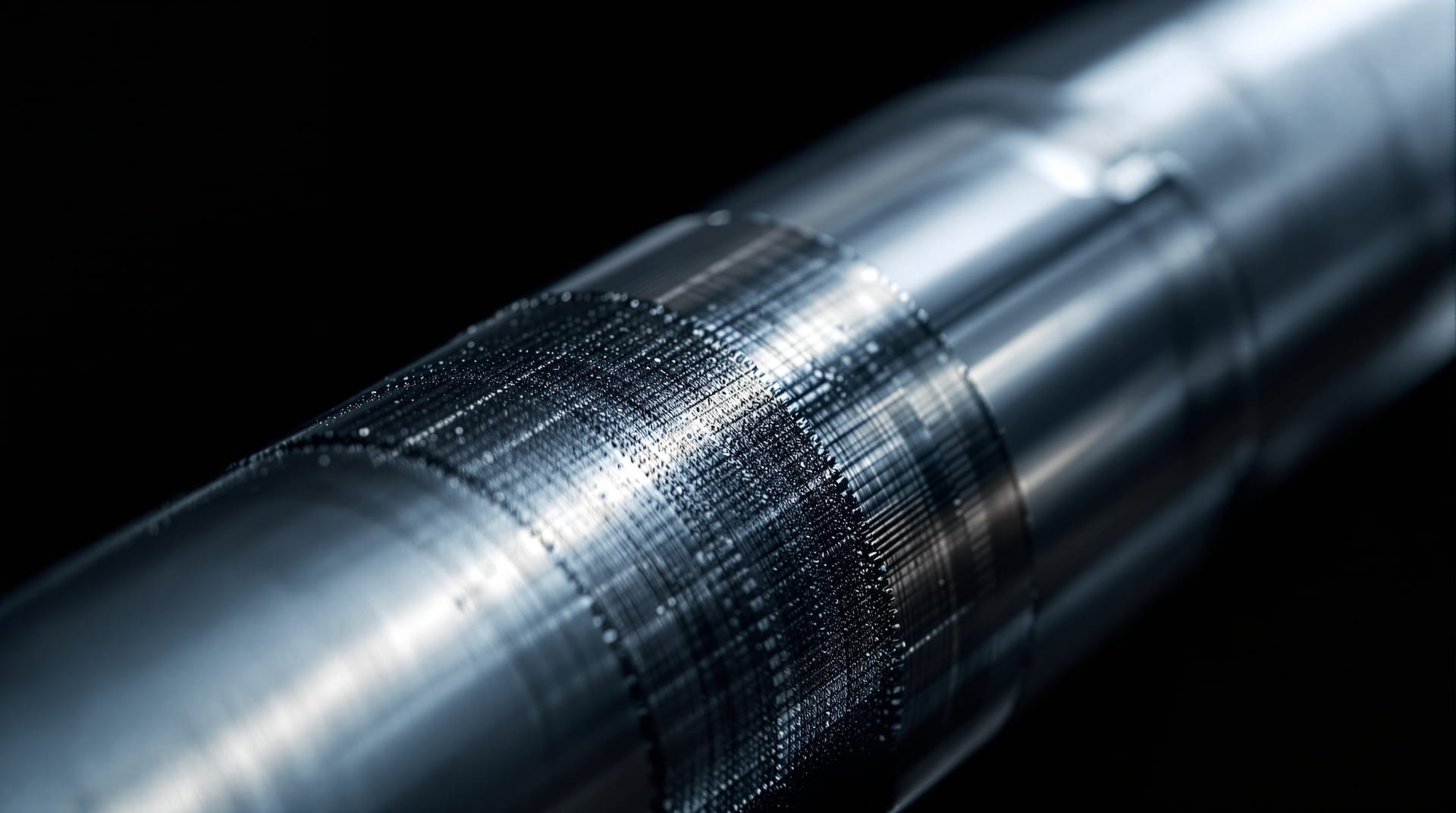
Drawn-over-mandrel tubing — DOM — is a cold drawn, electric resistance welded tube. The name describes the last operation in its manufacture rather than a chemistry, which is a persistent source of confusion: DOM is not a grade, and asking for "DOM" without naming a material is an incomplete specification.
Independent reference. This is an independent, non-commercial reference on metal forms, grades and mill processes. It sells nothing, quotes nothing and takes no orders, and it is not affiliated with any metal supplier, distributor or mill. See about this reference.
How it is made
The sequence runs as follows.
- Flat strip is formed progressively into a tube.
- The seam is closed by electric resistance welding — the edges are heated by the current passing across the joint and forged together under pressure. No filler metal is involved.
- The weld flash, both inside and outside, is removed.
- Each tube is tested for soundness of the weld.
- Further hot processing may follow to increase or decrease the wall thickness and the outside diameter.
- The tube is cut to drawn length, coated with a drawing compound, and one end is crimped so the draw-bench grippers can take hold.
- It is drawn through an external die with a mandrel held in the centre, so the outside is sized by the die and the inside is sized by the mandrel in the same pass.
That final step is the whole point. Drawing a tube through a die alone controls the outside diameter and lets the bore wander; drawing it over a mandrel controls both surfaces simultaneously. The general mechanics are described under tube drawing.
The benefits
- High strength from the cold working process. Drawing deforms the metal below its recrystallisation temperature, which multiplies dislocations and raises yield and tensile strength substantially — no heat treatment involved. The same cold working mechanism is what makes cold drawn bar stronger than hot rolled.
- Excellent OD and ID concentricity. This is the reason DOM is preferred over cold drawn seamless for many mechanical applications. Seamless tube is produced by piercing a solid billet, and the pierced bore is not perfectly centred; the wall thickness therefore varies around the circumference. DOM starts from strip of uniform thickness and is sized on both surfaces at once, so its wall is far more even.
- Less machining to clean up. Because the starting geometry is closer to the finished part, less material has to be removed to reach a round, concentric bore — and less material removed means less time, less tool wear and less scrap.
- A predictable, uniform structure. The weld flash is removed and the drawing operation works the whole section, so the finished tube behaves consistently around its circumference.
Specification
DOM tubing conforms to ASTM A513 Type 5. That specification covers electric resistance welded carbon and alloy steel mechanical tubing, and Type 5 is specifically the cold drawn welded product. When ordering, the useful call-out is the specification, the type, the material grade, the outside diameter, the wall thickness and the length — in that order, because each one narrows what the previous one left open.
Where it is used
DOM's combination of strength and concentricity puts it into hydraulic cylinder bodies, bearing housings, machined bushings and sleeves, drive shafts, and — most visibly — the tubular roll cages and space frames of racing cars, where consistent wall thickness matters because the thinnest point governs the whole structure's behaviour in an impact. It also ends up in a great deal of ordinary equipment: exercise machines, seating frames, agricultural implements, conveyor rollers.
Where it is not the right answer
DOM carries a cost premium over ordinary welded mechanical tube, and if a part is a simple frame member that will be welded and painted, that premium buys nothing. It is also not a substitute for seamless tube in applications where a weld line is prohibited outright by code — regardless of how sound the weld is, the specification either permits welded tube or it does not.
Related: Free-Machining Metals: Benefits. Back to the articles index.